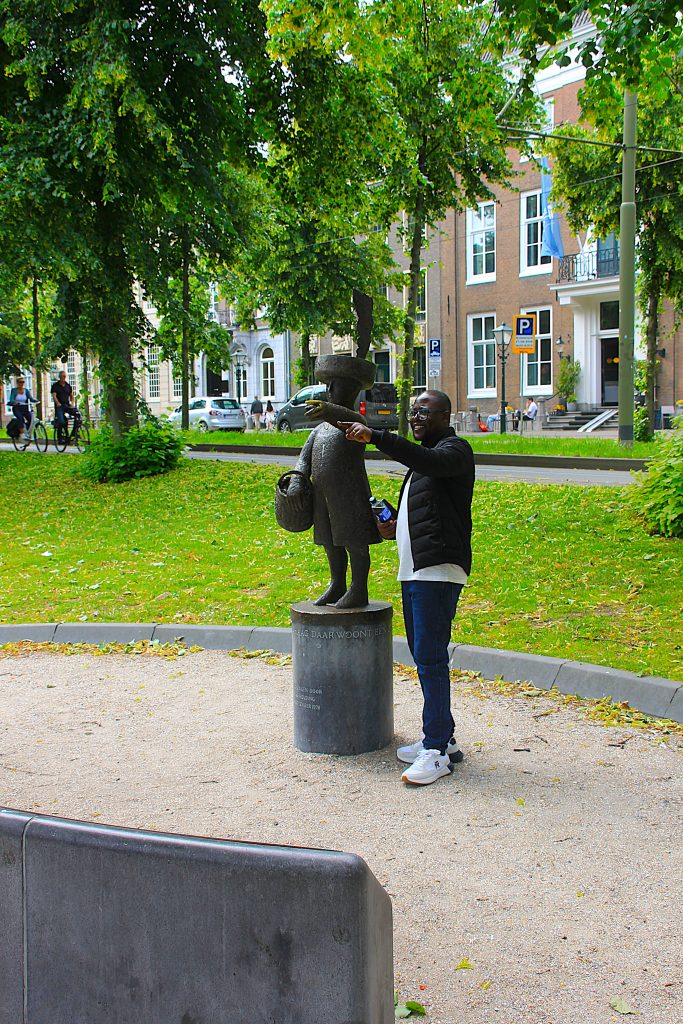
One of the things that stood out to me during our recent travels in Europe was the visible impact of focused vision and sustained effort. It made me reflect on Africa—our beautiful continent, richly endowed with natural resources, favourable weather, fertile land, and a remarkable history. Africa is also home to one of the earliest and greatest civilizations known to humanity: Ancient Egypt.
Yet, despite these enormous advantages, much of Africa has continued to lag behind other parts of the world in several key areas, including infrastructure, healthcare, education, technology, agriculture, and industrial development.
This raises an important question:
What happened? Why did Africa, which was once a cradle of civilization and knowledge, fall behind in many areas of modern development?
There may be many answers to this question, but one distinguishing factor that stood out to me was focus. From the beginning, much of the Western world seemed to develop a culture of relentlessly pursuing solutions to the challenges of its time. Scientists, inventors, engineers, and thinkers devoted themselves to particular problems and refused to stop until they discovered a solution. That is what I call the power of focus. When someone tells you, “I have given up,” perhaps the better question is:
“How long did you diligently pursue it before you decided to quit?”Many people abandon their dreams just when they are beginning to understand the problem. They change direction too quickly, start something else, and eventually become experts at starting but inexperienced at finishing.
There is a popular idea that mastery requires approximately 10,000 hours of deliberate practice. Whether or not the exact number applies to every field, the principle behind it is powerful: mastery requires sustained commitment, practice, patience, and perseverance. This how it works: 1 hour a day equals 27.4 years, 2 hours a day equals 13.7 years, 3 hours a day equals 9.1 years, 4 hours a day equals 6.8 years and 8 hours a day equals 3.4 years.
But it is important to understand that mastery is not simply a mathematical calculation of hours and years. It is about diligence, consistency, learning, experimentation, discovery, and the willingness to keep improving.You do not become excellent simply because you have spent time doing something. You become excellent when you remain committed enough to learn from the process and keep getting better.One of the factors that has hindered the development of our beautiful continent is the lack of sustained focus.
Africa has no shortage of brilliant minds, creative ideas, talented people, or natural resources. What we often lack is the continuity required to take an idea from conception to maturity. Political instability, economic challenges, changing priorities, inadequate systems, and other disruptions can interrupt the flow of ideas and prevent their consistent application.An idea should not die with the generation that conceived it.
The next generation should inherit it, improve it, expand it, and take it further.
There is something admirable about people who become identified with one thing they have mastered over many years. They keep showing up. They keep learning. They keep refining. They keep pushing the boundaries of what is possible. The start-and-stop mindset has wasted many great ideas and buried many valid dreams. Sometimes the difference between an idea that changes the world and an idea that disappears is simply the willingness to stay with it long enough. Our Lord Jesus Christ demonstrated this principle perfectly.His earthly ministry was governed by a clear sense of purpose and timing. He knew why He had come, and He remained focused on the mission entrusted to Him.
Consider the wedding at Cana in John 2. When the wine ran out, Mary brought the situation to Jesus. Yet Jesus responded:
John 2:4 NKJV
“Woman, what does your concern have to do with Me? My hour has not yet come.”
Mary may not have fully understood what Jesus meant at that moment. Perhaps, in a human sense, she could have thought, “My Son, relax! It is only a wedding.” But Jesus understood something deeper. He knew His mission. He knew His timing. He knew His hour. Jesus was not controlled by every immediate demand around Him. He was governed by purpose. That is the power of focus.
Focus keeps the mission before your eyes even when distractions compete for your attention.
What is your focus?
What is the one thing you have decided to pursue, develop, build, or become excellent at? Are your eyes fixed on something?
Jesus said:
Matthew 6:22 NKJV
“The lamp of the body is the eye. If therefore your eye is good, your whole body will be full of light.”
The word “single” in some translations carries the idea of being undivided, clear, or focused.
When your vision becomes clear, your energy begins to align with it. When you know what you are pursuing, you begin to recognize what belongs to the journey and what does not. You learn what to embrace and what to reject. You become more discerning about your time, relationships, opportunities, and resources. At first, you may not know exactly what to do, but stay with it, keep learning ,keep asking questions, Keep experimenting, Keep improving Eventually, something begins to happen. What once seemed complicated becomes clearer. You begin to understand what works and what does not work, what to do and what not to do—because you have stayed with the process long enough to gain wisdom through experience.
Focus produces clarity. Clarity produces direction. Direction produces consistency. Consistency produces mastery.
At some point, you must point at something and say:
“This is what I am going to pursue.”
Then give it your attention. Give it your time. Give it your discipline. Give it your patience. Give it your best. And somethimng will breakforth out of it. Your focus does not mean that you ignore everything else. It means that you know what deserves your primary attention. There will always be distractions. There will always be competing voices. There will always be easier alternatives and new things demanding your attention. But greatness is rarely built through constant movement from one thing to another. It is built through faithful attention to something meaningful over time.
Conclusion
Perhaps the dream God placed in your heart has not failed. Perhaps you simply stopped working on it too soon. Perhaps the idea was not wrong. Perhaps it needed more time, refinement, and persistence. Perhaps what you called a delay was actually a season of preparation. Do not be too quick to abandon what God has called you to build. Point at something. Focus on it. Work on it. Learn from it. Improve it. Give it time. And as you remain faithful, remember that focus is not merely about concentrating your eyes; it is about aligning your heart, time, energy, and resources with a clearly defined purpose.The world does not need more people who start many things and finish few. It needs people who are willing to stay the course, cultivate what they have been given, and carry an idea beyond themselves.Point at something. Give it your attention. Stay with it long enough for the light to come. Because when focus is in place, clarity eventually follows—and where there is clarity, there is a path forward.
Be Blessed
Pastor Elias
Very insightful and a valuable lesson on being consistent. Thank you pastor Elias for bringing the lesson to the fore.